Mostrando entradas con la etiqueta big size tents. Mostrar todas las entradas

viernes, 27 de marzo de 2015

Ctents was at HOMSEC, International exhibition of Security Technologies

Homsec registered more than 11.000 professional visitors from 40 different countries

Homsec was opened by Spanish Home Affairs Minister.

Military tent CtentsCtents showed one of its professional tents and received the interest of many of the attendants interested in developing camp hospitals and military training camps, and in endowing their armies or emergencies, security and civil defense teams with Ctents.

Also some technological companies has shoen their interest in using Ctents for remote areas work where they install communication systems.

Lightweight military tent CtentsCtents awakened high interest between visitors coming from countries such as Venezuela, Egypt, Ecuador or Indonesia and of course from Spain, Italy and other European countries.

After the intense three days of exchanging cards with visitors now we are working to customize the best solutiions for them.


If you liked this article, please recommend it to a friend, thanks!
Please leave your feedback.

miércoles, 4 de marzo de 2015

Ctents will be at HOMSEC Exhibition, IFEMA, Madrid, March 10th to 12th

HOMSEC: 5º Salón Internacional de Tecnologías de Seguridad Nacional

Emergency tent CtentsCtents will be present at HOMSEC, on March 10th to 12th, at IFEMA's pavillion 7 stand B03, Madrid, where it will take place the 5th International Exhibition of Security & Defense Technologies, at our partner Tolder's stand.

In the exhibition we will show a tent Ctents, model 450 of 10 m2, which can be used for secrity and emergencies purposes.

More than 11.000 professional visitors are expected with more than 180 exhibitor companies.


All weather snow resistant tent Ctents

If you liked this article, please recommend it to a friend, thanks! Please leave your feedback.

jueves, 25 de septiembre de 2014

(vi) Tents and shelter. Hidden costs in humanitarian aid and emergency. THERMAL ISOLATION.

What is the purpose of a flysheet in a tent? (Second function)

As I said before, a flysheet in a tent is supposed to offer thermal isolation for the users, but it is really hard to find a tent that has a flysheet capable to meet this expected function.

The main reason is that to make it possible to create a thermal isolation it is needed to have a physical barrier between inner fabric, the body, and outer one, the flysheet.

The purpose is that the air surrounding the tent finds something between outer side and the interior, capable of reducing the thermal transmission, in cold weather avoiding inner air being as cold as outer one and in hot weather avoiding inner air being as hot as outer one.

In architecture and construction, in a simplified manner, there have been historically three main ways to reach this goal: first very effective way was to make a thick barrier, sometimes even one meter wide; second way adopted, not so effectively, was to reduce this thick walls in order to save money in the house building substituting it with lighter materials and using inner layers of isolation materials and leaving some space for creating an air barrier, and finally it was discovered that one third effective way to create a chamber of air in movement, between inner air and outer air, keeping this air chamber between two layers of material. This is the effect known as ‘ventilated façade’.

 
The ventilated façade works as follows:

When the sun shines, the air inside the chamber is heated and it starts to flow to upper areas. As the hot air goes up, fresh air occupies the space abandoned by hot air, bringing fresh air inside the air chamber, if the hot air has an escape way to flow to the atmosphere, this movement becomes continuous and the flow of air avoids the inner air inside the tent getting hotter.
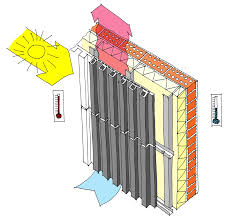
The outer layer that creates the outer closing side of the barrier also avoids the sun to impact directly on the inner body and helps also, in this way, to reduce the inner temperature.

The air barrier between outer layer and inner layer creates a difference, a gradient, of temperatures, keeping the interior fresh.

When the weather is cold outside, the same effect is produced. But with some differences: If the hottest air is not allowed to escape the air chamber, the air inside the chamber maintains a higher temperature than interior and avoids the interior to lose temperature. In this way, the air inside the chamber is a barrier that avoids inner air to cool too much.

When we analyze most tents in the market, we can easily find that the immense majority of tents have a flabby flysheet (those which have one) that is not capable to be tightly separated from inner body, even many of them commonly touch frequently the inner layer. This kind of flysheets are not capable of keeping an air chamber functioning.

Thermally isolated tent CtentsTo have a real air chamber capable of producing thermal isolation it is needed to have inner and outer layer permanently separated. Otherwise, the free circulation of the air inside the chamber would be obstructed and the air chamber wouldn’t work.


To have a tight flysheet separated of the inner layer and to keep both layers stretched permanently it is not an easy task. Ctents is a tent that shows that it is possible to create a ventilated façade effect for a tent.

If you liked this article, please recommend it to a friend, thanks! Please leave your feedback.

miércoles, 17 de septiembre de 2014

(v) Tents and shelter. Hidden costs in humanitarian aid and emergency. PROTECTION OF USERS.

What is the purpose of a flysheet in a tent?


A flysheet in a tent has a double function:

1) Protect the inner body of the tent of being directly exposed to the inclement weather.
2) Offer thermal isolation for the users.


First function is the most known one, but it is really hard to find a tent that has a flysheet capable to meet the second. In spite of that, quite a few tents do not satisfy well at all the first.

Why not? 

Take a break to leave me your feedback.

The reason is very simple: A flysheet is like a roof in a house. Can any of us imagine a roof in house that is not well fixed and that does not maintain its shape when the wind blows or rain, hail or snow falls? Of course not!, nobody would think in building a house where the roof can easily move, making waves and forming pockets where the water can accumulate and produce leakages in the interior.


This appears to be obvious for a house, but, why it is not so for a tent?

It is common to find tents that have a flysheet that works more or less well when it rains... not intensely, but it is very easy also to find many tents that have a so called flysheet that easily get loose when the wind blows or the rain drops heavily, and it is quite difficult to find many capable of standing well a hailstorm. In fact, in these cases, this piece of fabric cannot be called properly a ‘flysheet’, but just a ‘second fabric layer over the tent’ with mostly a psychological function for users.

To have a flysheet in these tents working effectively it is necessary that users keep themselves very aware of weather, in order to quickly readjust the tensors of the flysheet as soon it is not stretched enough and also they have to be very careful to avoid touching inner layer as they could connect the inner to the outer layer provoking a leakage. In fact it is not very comfortable to go camping and to have to suffer these unpleasant jobs in the middle of the storm instead of feeling protected inside.

To put things clear: In order to have a flysheet that really performs its first function, it has to keep stretched tight under inclement weather conditions (when it is really expected to perform its function), but traditional constructive solutions for tents do not solve this problem without the careful monitoring of the users, ready to tight the guy-ropes and tensors when the flysheet begins getting too loose.
Robust all weather tent Ctents
To solve this question the trick is going back to the concept; to understand well what this piece of fabric is intended for, and then, to design it in such a way that really works as expected. Without human intervention!

Otherwise we, as designers and manufacturers, will not be offering to the users what they need: A reliable tent that takes care of them when the weather is not an ally.

Next week I will talk about the forgotten one by most of the manufacturers, the second function of a flysheet.

Please leave me your feedback.

If you liked this article, please recommend it to a friend, thanks!

martes, 26 de agosto de 2014

(iv) Tents and shelter. Hidden costs in humanitarian aid and emergency. TRANSPORT & STORAGE.

Is it just the price of the emergency tent the only important thing for taking the right decision when selecting a tent for emergency brigades?


When a buying decision has to be made, it is important to consider all its implications. To buy a tent is not just a matter of choosing anyone, like when one goes to the pastry shop, looks at the pastries and selects one for its shape, colour or by its expected taste.

For rightly selecting a tent the thing is something a bit more complex.
When a tent is going to be used in a future, and is not yet clear to what country or climate it will have to travel, and it is not clear either if it is going to be used just for people of one sex or both, if it is going to be used in a place where it is going to rain a lot or, instead, in a dry one, and the tent will have to spend part of its life stored in a warehouse waiting for an emergency to arise, and then be shipped quickly to a distant country where it is going to be useful for someone, then, the selection of the tent should take into consideration the different possibilities. 

The tent to be stored should include every element that could be needed at the emergency site, 
for instance, inner separating curtains, flysheet, floor, and others.

To store a tent should be done in an easy way, having packages easy to carry by hand and that can be stacked in order to minimize the warehousing space, and therefore reduce costs, and also making it easy to find the correct package when needed.

As all we know, when the emergency situation happens, there is no much time left to think and debate, is time to act fast, in order to help as soon as possible those who happen to be in the middle of the human drama.

Someone is going to pick up the needed tents from the warehouse and to prepare a shipment to the emergency site, the first shipments usually by plane. This person maybe do not knows anything about tents. At that moment it becomes critical to ensure that all the packages corresponding to the same emergency tent are shipped together and that the possibilities for them to be separated from each other are reduced to a minimum..., and that should be done with the minimum effort and minimun knowledge needed!

The tents will usually be loaded in a truck where the use of space is crucial, it should be possible filling the truck completely (without overload it) and then transfer the packages to the corresponding aircraft hold. At this time, it is also critical - before, it already was - the weight to be transported, as every kilo in an airplane counts a lot. To send an airplane plenty of emergency material is not cheap, to be able to send as much material as needed with the minimun weight, is a must.

For the above reasons a tent should be designed having in mind all these factors:

1) Minimun weight for maximun useful tent surface

2) Simple packaging including all the pieces that can be needed in different emergency situations

3) Better 1 package for a tent than 2 or more, as more packages, more easy to mislay one or to lose it completely. When one of the packages is not there at the emergency site, the rest of the tent can become unuseful.


4) Package shape should be as much as possible like a parallelepiped in order to there are no hollows left in the truck or in the aircraft. The rental of the plane, specially is going to cost mainly for the plane itself, so, in some manner we could be paying for transporting hollows, plenty of air, and, of course, we should avoid that happening.

5) As the tents are going to pass from one place to another, and usually not small quantities of them, the best way to carry a number of them, to fill the aircraft hold or to offload it, is with a forklift, but the best way to transport load with a forklift is within pallets. The best thing should be that the tents had pallet like size, in order to the load is distributed uniformly and organized adequately.

6) Each tent should be as easy as possible to be carried by human beings, as they are the ones who will put them in place at the emergency site before the tents are assembled.

To summarize, the big issues for pakaging and transport are:
Easy to transport tent bag Ctents
  • Minimum specific weight kg/m2 of useful surface
  • Every element needed included in the package
  • 1 package for each tent
  • Package with parallelepiped shape
  • Package dimensions compatible with international standard pallet size in order to fill it completely
  • Easiness of carrying.
One of the things most surprised us when we began to work on this aspects of tents design, is that most of the manufacturers have ignored these seemingly obvious criteria, if anyone has consider it!

If you liked this article, please recommend it to a friend, thanks! Please leave your feedback.